Eighteen incarcerated people housed at Unidad Penal N°15 de Batán completed, between October 2025 and May 2026, the pilot program of the Programa de Salud Mental Comunitaria de Liberté, which the cooperative runs together with Mutual AMI. All care was delivered entirely by videoconference, from the room Liberté maintains inside Batán. The transition toward the permanent program, beginning in June, is now underway.
A pilot that sustained eighteen clinical journeys
The pilot program ran from October 2025 to May 2026, with a concrete goal: to test a psychological care model for people housed at the Batán facility, delivered entirely by videoconference. Each person who sought care went through an individual clinical process, organized around an initial assessment of up to four sessions and a treatment phase of up to twelve sessions with goals defined collaboratively.
The partnership with Mutual AMI gave the model a solid institutional foundation and helped ensure the economic sustainability of the participating professionals. Cooperativa Liberté provided the physical space, connectivity, appointment scheduling, and coordination, led by Lic. Ricardo Augman.
The central role of connectivity
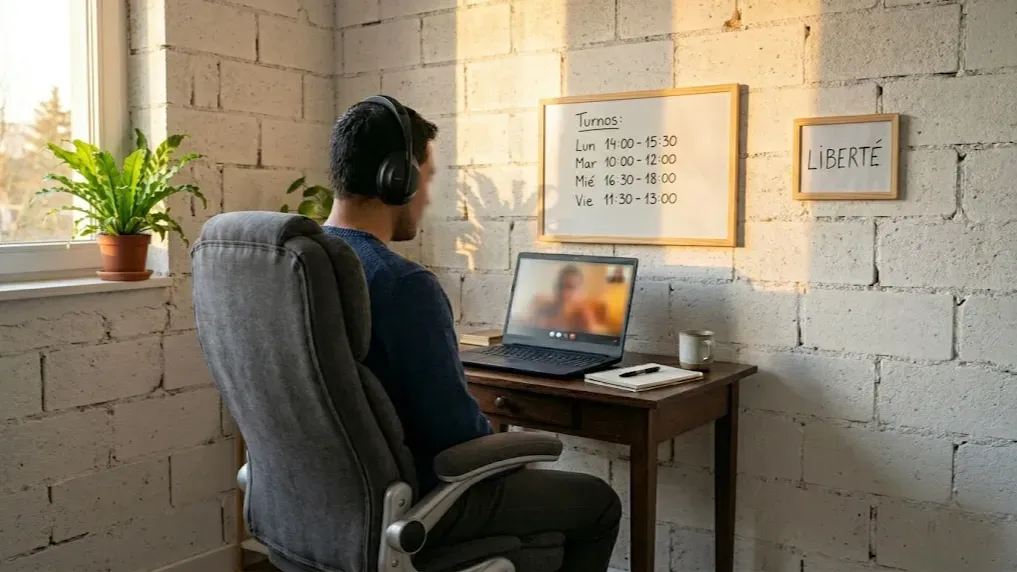
This program exists because of connectivity. Without the digital infrastructure that Liberté maintains inside Batán, there would be no way to connect incarcerated people with professionals offering their services remotely and at solidarity-based rates. In this case, technology becomes a concrete bridge between those who need care and those who can provide it.
Sessions take place in a room within Liberté's space, prepared by the incarcerated people themselves using the available resources: modest, comfortable, acoustically treated.
"When we started, we had more questions than certainties: whether videoconferencing would work as a therapeutic space, whether people in incarceration would be able to sustain a process from inside the prison, whether our structure could guarantee the regularity of sessions. Today, after eight months, we can say yes. And that is not a small conclusion."
What we learned from the pilot
This is the foundation on which the permanent program is built. The observations accumulated over these eight months allow us to refine the model across three dimensions.
The first is adherence to the clinical structure. The combination of up to four assessment sessions followed by a treatment phase of up to twelve sessions worked as an operational framework and allowed people to sustain a process with a clear beginning and end. The second is institutional coordination: the relationship with the facility requires prior agreements and respect for its schedules, and Liberté's presence inside Batán was what made the model viable. The third is the role of the Health Facilitator, a Liberté member who receives requests, coordinates appointment and professional assignment, and maintains communication between all parties throughout the process.
Toward the permanent program
Starting in June 2026, the Programa de Salud Mental Comunitaria de Liberté leaves its pilot status and is established as a permanent service of the cooperative. This new phase expands care capacity with the addition of a team of psychologists based at different points across the country, opens access to new people in incarceration, and increases the program's overall volume. In a second, gradual phase, care is planned to extend to family members and household members of people currently receiving treatment.
The overall structure remains the same: individual care by videoconference from the Liberté room in Batán, partnership with Mutual AMI, and coordination by Lic. Ricardo Augman. What changes is scale — a team of psychologists working simultaneously, distributed across the country — and continuity. The program becomes a stable, open-ended offering, no longer bounded in time.
Information on how to access the program, admission criteria, and referral contact channels will be available on the Programa de Salud Mental page starting at launch.