
The class begins with a thank-you and a definition: "an open-air classroom." It's July 2025, at the huerta Don Raúl belonging to Perla Colombo, in Camet Norte, a hundred meters from the sea. There, Mauricio Matías Navarro filmed three episodes for the Libertad Alimentaria y Hábitat Sustentable ("Food Freedom and Sustainable Habitat") diplomatura at Universidad Liberté — the program that in 2026 was renamed Cultivando Soberanía ("Cultivating Sovereignty") — with a brief that isn't the one from a manual: show a real garden, in winter, with the wind against you.
The three episodes, twelve minutes. Everything that follows comes from here.
Because that's the first lesson, and it isn't stated as a lesson. Filming a garden in June and July, with "intense cold spells" and "so many weather conditions working against you," is choosing the worst possible moment to show it off. Navarro chooses it anyway and says so twice: it's hard to have plant material in good shape at this time of year. The garden you see isn't the one from the brochure.
"Our quinta is the huerto"
Before touching the soil, the class pauses on what to call what's being looked at. What you see — fruit trees mixed with vegetables — has its own name: in some places it's called a frutedo (Spanish for "fruit garden"), for the combination. In Argentina, "quinta" usually names something else, a setting that includes animals, the country house. Navarro undoes the knot without asking permission.
Depending on the country, the latitude, the place in the world where you are, it's going to take on different names. We can also call it a garden. This is a part of the earthly paradise garden we inhabit, that we need to take care of and that we need for our subsistence.
The clarification seems minor, and it isn't: in a diplomatura taken from different countries, agreeing on the word is the condition for understanding each other about the practice.
What protects what grows
In that plot grow lemon trees, almond trees, apple trees, fennel, beets, spring onions, and culinary and aromatic herbs. None of that would be possible without what isn't harvested: the phormiums, the casuarinas, and other species that act as shelter. The garden, then, begins with what surrounds it.
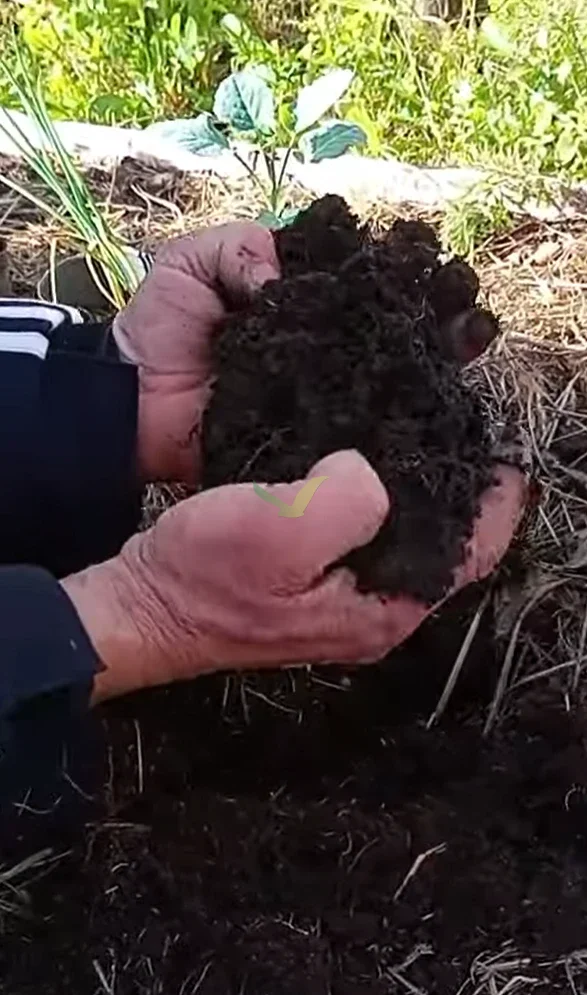
The soil, "a kind of living organism"
The second episode is about the soil, and that's where the heart of the class lies. The proposal is to add organic matter — harvest leftovers, dry grass, compost, vermicompost, bio-preparations, microorganism inputs — with a goal Navarro states without metaphor: that the soil in the bed be a kind of living organism, capable of resilience and nutrient balance.
And then comes the method, which is what sets this class apart from a theoretical explanation. How do you know if soil is healthy: you smell it.
A soil in the first layers, the first few centimeters, very organic, with lots of humus, with lots of life. We can smell it, and we'll notice a pleasant smell of forest earth. That tells us it has good health, good soil quality.
The second thing you check by touch: loose, well-aerated soil lets you sink your fingers in. And the third is the most political statement of the class, said almost in passing. Starting from rubble or asphalt doesn't condemn the plot: working with organic matter, "we can turn that into this, at least in the topmost layers." Soil isn't a destiny.
Seven degrees: measuring before transplanting
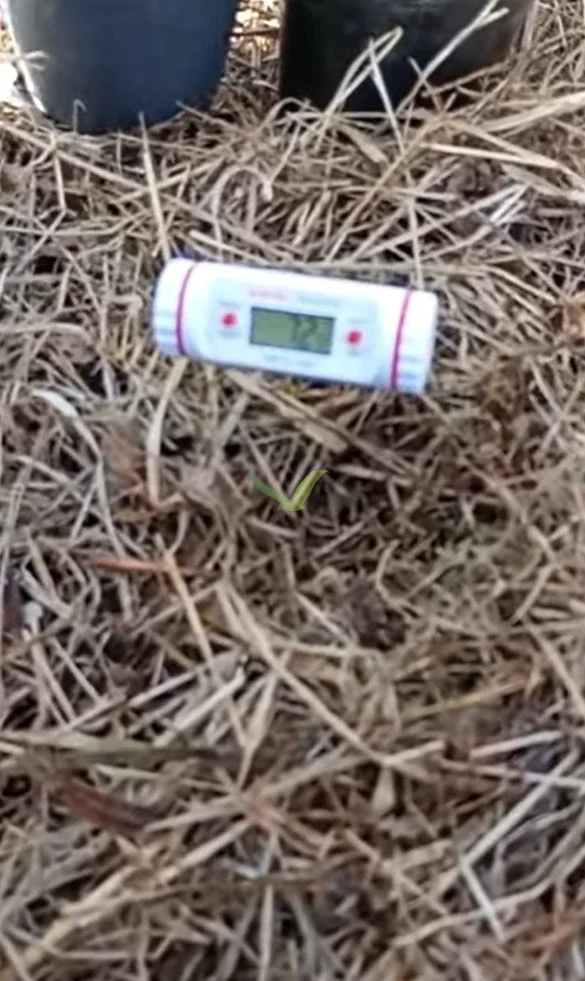
The class takes measurements on camera. Eleven point one degrees of ambient temperature at crop height. Between seven and six and a half in the first five to ten centimeters of soil. Seven point two at transplant depth.
The number matters for what it allows and what it doesn't. For transplanting, it works. To sow spring and summer species you'd need fourteen degrees. That's why the season is, in his words, "an interface of change": under cover you sow what will be transplanted in September, October, and November; directly into the ground go garlic, onions, peas, and fava beans. "And not much more in this area."
The mulch does three jobs at once
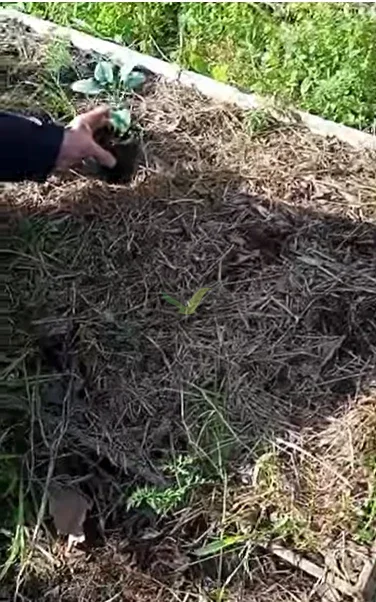
Over the prepared bed goes the mulch, and Navarro justifies it by piling up reasons: it controls species that compete with crops, saves water, protects the surface from raindrop impact and sun, prevents erosion, and concentrates nutrients. At the end he adds the argument that outranks all the others: it's a control method that's "far more efficient, with lower energy cost."
There's also a warning about how to work the bed: once it's been loosened and enriched, don't invert the horizons, don't keep turning the soil over planting after planting. What organic matter builds up, a shovel can undo.
Under cover: where next season begins
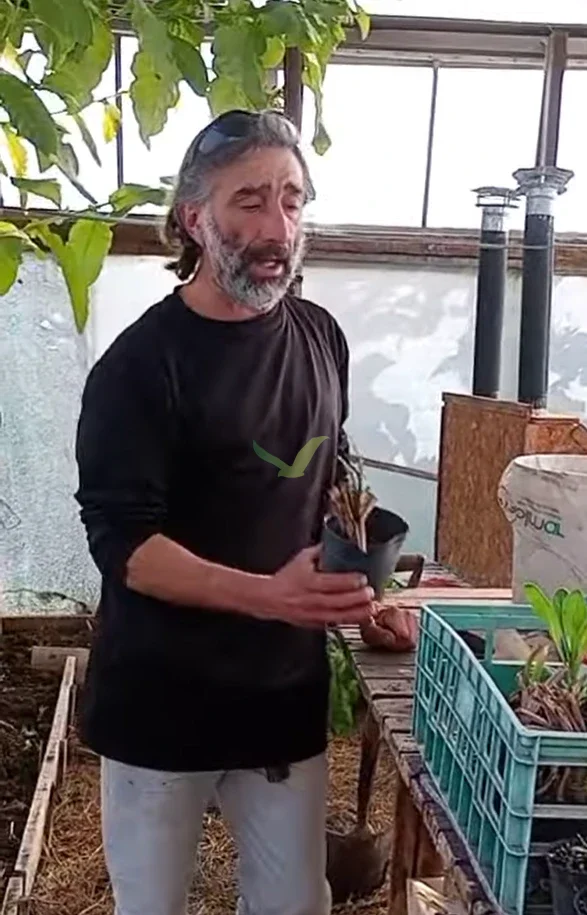
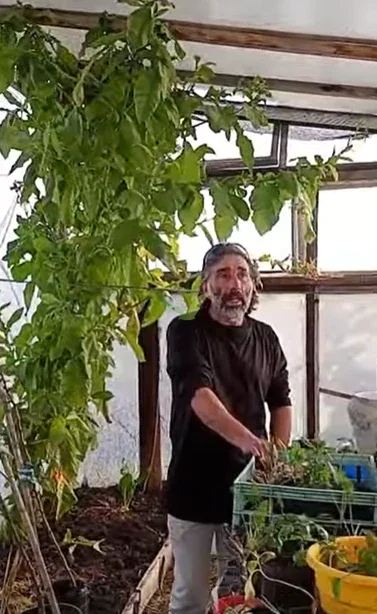
The third episode, from July 5, 2025, is filmed inside the greenhouse. It's both a seedling nursery and production space, and that dual use is the point: in a commercial garden the greenhouse does one job; in a home, institutional, therapeutic, or productive garden it can have "triple, quintuple function, whatever functions you want to give it."
There, tobacco grows in full summer, with agroecological management: bio-inputs produced on site and the occasional commercial input accepted in organic farming, such as diatomaceous earth. The conclusion is that you can produce in a modified environment with quality, health, and low impact.
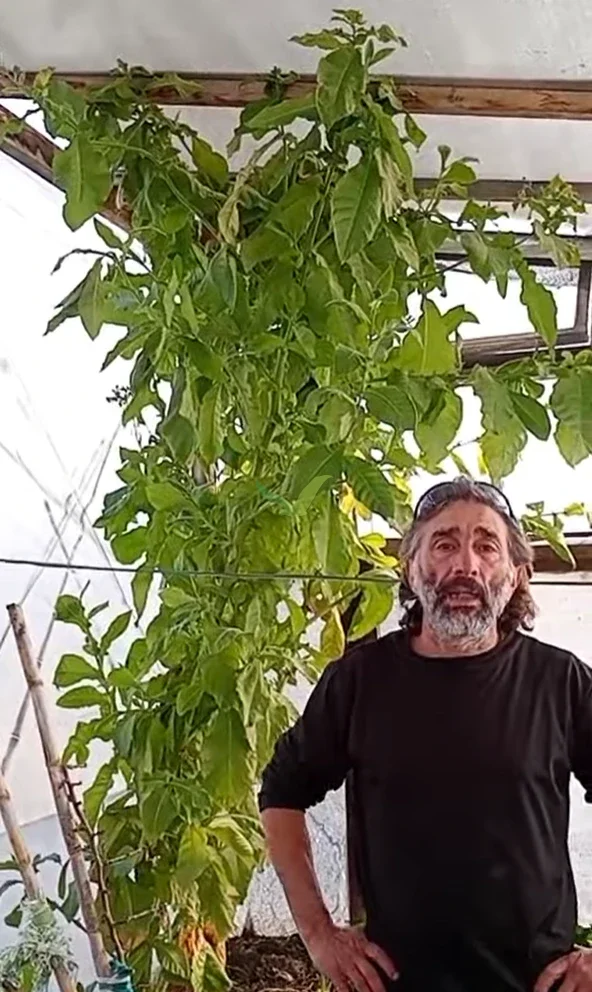
And a distinction that sounds technical and isn't. When soil is used to fill pots, it stops being soil and becomes substrate: the support for a crop that will stay there for a while before going to its final spot. Compost, earth, sand, perlite, vermiculite, depending on what's available in each area. The recommendation is repeated: lots of organic matter, lots of life, giving looseness without compacting.
A class you can teach anywhere
Among its focus areas, the agro-area diplomatura works on agroecology in small spaces: a balcony, a patio, a terrace, a dining hall, a prison. This class fits right in without any translation needed. What it teaches doesn't depend on the size of the plot or on what you start with — rubble, asphalt — but on a sequence: look at the surroundings that protect it, feed the soil, measure it, cover it, and don't undo it.
The program is open to the whole community, both inside and outside the Unidad Penal N°15 de Batán, and is part of what Universidad Liberté offers together with Cooperativa Liberté.


