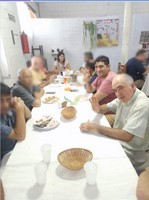

"I didn't come to prison to make friends." It's a phrase you hear often between these walls. Said by people who just arrived and by people who've been inside for years. Today, July 20th, Friendship Day in Argentina, we look at it again.
It's a phrase of self-protection. In a place built for isolation, making a friend means exposing a flank: trusting someone, owing something, showing that you care. Saying "I didn't come here to make friends" is a way of getting ahead of rejection, of protecting yourself from disappointment. Above all, it's a way of naming loneliness without saying its name.
What the old saying tells us
But there's another phrase, an older one, that goes in exactly the opposite direction: it's in prison and in the hospital that you find out who your true friends are. Prison as a filter. The place where everything unnecessary falls away and what's real remains: the one who keeps writing, the one who travels for visits, the one who shows up when the day goes wrong. Both phrases live in the same hallway. One is the armor; the other is what happens when the armor comes down.
Affection as resistance
People who study life on the inside have seen this and given it a name. Anthropologist Carmen Osuna, who researched affection in a women's prison, wrote that prison —with all its violence— still leaves "openings for care and affection," and pointed to the classroom, the school, as the place where those encounters happen. Affection there is not weakness. Having someone to talk to, sharing a mate or a task, looking out for one another: that's what keeps spirits up and protects the mind in a place built to wear it down. It's a way of surviving the coldness of confinement. A strategy of resistance.
Self-management does the opposite of armor
That's exactly what shared work produces. In the workshop, in the cooperative, shoulder to shoulder, you find the mate being passed around, the person teaching a trade, the one who backs you up. No one went looking for those friends: they were built by the work of standing side by side, every day. Self-management —splitting up a task, holding up a decision together, taking joint responsibility for making something work— is, word for word, the opposite of "I didn't come here to make friends."
Liberté is the proof. It was founded in 2014 to solve what wasn't being provided —starting with food— and grew from two people to more than two hundred. It's made up of people in prison, victims of crime, people who have been released, judges, lawyers, professionals, and neighbors and family members: people who, outside these walls, would have no reason to cross paths, and who here share a table, a task, a project. That friendship is born out of that mix, in a place designed to prevent it, is no small thing: it's proof that the bond insists on existing. When a person in prison and a victim of crime end up caring for each other, working side by side, something that seemed broken forever gets repaired in practice. It's rebuilding, step by step, a community bond that crime and prison had cut.
No one comes here to make friends. But when you work side by side with someone, day after day, friendship happens anyway. That's what we've learned here.
Not just Liberté
Today's greeting isn't only for us. Inside prisons there are many groups, collectives, and organizations that sustain self-managed work: people who organize themselves without anyone directing them from outside, often within their own cell block, to study, produce, look out for one another, and demand what's rightfully theirs. Each one of those spaces produces the same thing ours does: fellow companions. Friendship where it wasn't expected.
Happy Friendship Day
To every companion who found someone to rely on at Liberté. To those who walk in for the first time and stay guarded, as is only natural. To those who one day let their guard down and allowed themselves to be accompanied. And to everyone who, on the inside, organizes so that others can be better off. Today's greeting is for all the friends that self-management made possible: thank you for proving that not even prison can defeat friendship.