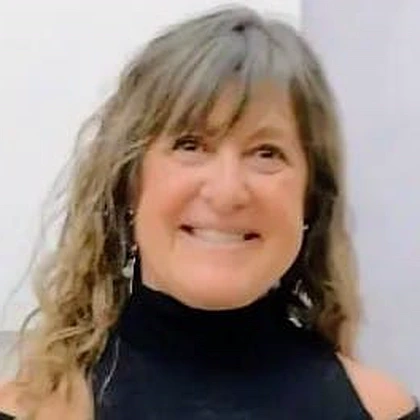

On Friday, November 13, in the Punto de Paz hall of Batán Penitentiary Unit No. 15 and over Zoom, Liberté University and Cooperativa Liberté, with the support of the Víctimas por la Paz Civil Association, held a new enClave Libre. The topic was a question that remains open: what do we do about cell phones in prisons? Lawyer Telma Verónica Vargas presented it in person; sentence-enforcement judge Juan Galarreta gave the response; and from the hall and from several penitentiary units, people in prison who use their phones to study and to talk with their sons and daughters spoke up. It lasted two hours and six minutes.
Editors' note
This Chair is based on the automatic transcript of the class, its captions, and the slides and research work of Vargas, which garble proper names and figures; we have written them with the correct spelling. What appears between “ ” is the speaker's own words, with verbal tics cleaned up. The rest is an account of what they said, credited to them. The numbers of raids and bills are those stated in the class; we did not verify them against the original reports.
“Being networked”: why a cell phone is more than a call
The session began with an introduction by the announcer in Batán and greetings from Diana Márquez, secretary of the Board of Directors of Cooperativa Liberté, who presides over the Argentine Society of Restorative Justice (SAJuR) and heads the Víctimas por la Paz Civil Association. Ricardo Augman, treasurer of Cooperativa Liberté, psychologist and researcher specializing in community mental health, joined by Zoom. Augman remembered Juan Carlos Vesulla, a collaborator of the Marcos de Paz program of the National Penitentiary Ombudsman's Office, who had died that week. Then he set the tone for the topic: the cell phone is not only communication.
“Devices have existed in prisons for a long time, but what makes the difference is that the devices are networked. And every time a community gets networked it becomes very powerful and, of course, it awakens enormous fantasies.”
Márquez, who had invited Vargas, explained why Liberté University holds enClaves: it is a format that gives the expert time to develop the topic calmly, and that lets everyone else think along. Then Vargas thanked them for the invitation, highlighted that the space brings together people who work in the judiciary, sociology, criminology and criminal law, and shared something that was already happening while she spoke: some of her students and former students from the litigation workshop at the National University of La Plata were connected from penitentiary units, and they were doing so thanks to a cell phone.
The map: nation, province and sentence enforcement
Vargas proposed organizing the class in two periods, cell phones before the pandemic and after, and limited herself to the province of Buenos Aires. First she laid out the legal map. The Constitution divides powers: the provinces delegated the Criminal Code to the nation and reserved their procedural codes and their sentence-enforcement laws. Hence national law 24,660 and Buenos Aires law 12,256, from 1999, coexist. With the Buenos Aires Procedural Code, in force since 1998, a decision was made: to bring the enforcement stage under judicial oversight. The sentence-enforcement judge was born, who resolves issues about early release and is the one who reviews disciplinary sanctions on appeal.
Law 12,256 recognizes the right of people in prison to communicate with the outside world (visits, reading, education, work, leisure) and states what for: to achieve better social integration when they get out. And it classifies offenses as minor, medium and serious. Two mattered for cell phones: the medium offense of “maintaining or attempting clandestine contacts” and the serious offenses of bringing in items by evading controls.
Before the pandemic: an offense or a right?
The rule did not say “cell phone.” And there, Vargas explained, the courts split into two positions. The first, of interpretive laxity: if someone attempts a clandestine communication, the law does not need to name the cell phone, because there is no other way to do it; so the sanction was upheld. The second applied the principles that reduce punitive power: maximum specificity (if the rule does not say it, the judge cannot add the conduct) and the prohibition of analogy to the person's detriment. With that second position the sanction was overturned.
There was also a deeper debate, that of harmfulness. The dangerousness-based view held that the cell phone facilitated escape, the entry of dangerous items or continuing to commit crimes with accomplices outside. On the other side, Vargas cited Mario Juliano, judge in Necochea, deceased, eternal godfather of Liberté, who as early as 2013 answered with the logic of the absurd. What she projected on the slide:
“The use of generic and imprecise concepts for the reproach (clandestine communications) causes logical breakdowns in the system. Indeed, with the same intention […] the landline telephones that exist in each cellblock […] should be eliminated, private correspondence and general and conjugal visits should be prohibited, or mandatory silence should be imposed to prevent conversations between detainees.”
If having a cell phone were dangerous, Vargas summed up, it would have to be taken from everyone, inside and outside. And being in prison does not repeal equality or the status of being a person.
The pandemic: no visits, and the habeas corpus for Batán
Decree 297/2020 imposed mandatory lockdown from March 20, 2020, and made no distinction between those who were free and those who were in prison. The consequences were immediate: families could no longer visit, and those who enjoyed temporary release or semi-custody could no longer leave. First there were individual claims, through defense lawyers; then human rights bodies such as the Provincial Commission for Memory joined in, and the filings became collective. They were resolved by the judge on duty, so criteria varied according to the judicial department.
The case Vargas brought to the local setting was the collective habeas corpus filed by the Provincial Commission for Memory over the Batán Penitentiary Complex, which Judge Galarreta resolved on March 27, 2020, and who was present in the hall that Friday. His grounds: that prison deprives of no rights other than liberty (as the Supreme Court had already said in “Dessy”); that the principle of legality also applies in sentence enforcement; and that, therefore, using a cell phone is an atypical conduct. He also cited the Inter-American Court (Almonacid Arellano v. Chile): the State must remove not only rules that obstruct a right, but also practices. And the cell phone, she explained, also fell within the differentiated protection of people in vulnerable situations. The ruling allowed their use and instructed the complex's leadership and management until a protocol was in place.
Three days later: the Court of Cassation and the Buenos Aires protocol
Just three days later, the provincial Criminal Court of Cassation (Chamber II, case 100,145, “Detainees housed in Penitentiary Unit No. 9 of La Plata s/ collective habeas corpus”) ruled in the same sense, with the opinion of Dr. Víctor Violini, which took up Galarreta's arguments:
“Deprivation of liberty does not imply —nor can it imply— the curtailment of other basic rights, such as those relating to food, health, education, assistance and maintenance of family ties.”
The Court of Cassation assigned the Ministry of Justice a protocol, which remains in force. Vargas summarized it: it has three objectives (contact with relatives and loved ones, educational and cultural development, and access to information about one's procedural situation); the cell phone is used only in the place of lodging, at any hour, with no removable memory, no social media (only WhatsApp). And it includes something that, she said, is not being looked at in today's debate: for those who committed crimes through social media or electronic devices, the Ministry may regulate the use or even remove it. It is not uncontrolled use.
The 2021 question: were more crimes committed?
Vargas said her research began in the specialization in Criminal Law at the National University of Mar del Plata, in the Criminology course, in June 2021. The paper is titled “¡Cuidado, tiene un celular!” (“Careful, he has a cell phone!”) and her question was a single one: whether the authorization during the pandemic had increased crimes committed with cell phones. She explained how she narrowed it down so she could do it alone: convicted and prosecuted adults, no juvenile criminal system; only the Mar del Plata Judicial Department and the Batán Complex; no federal jurisdiction; and four crimes that can be committed with a cell phone: grooming, threats, extortion and fraud.
First she went to the official statistics, those of the Attorney General's Office and the Departmental Prosecutor's Office. The slides show, for the four crimes, the numbers for two periods (March 20 to June 25, 2019 and the same stretch of 2020):
| Crime | 2019 | 2020 |
|---|---|---|
| Grooming (art. 131) | 15 | 12 |
| Simple and aggravated threats | 1,383 | 776 |
| Extortion (art. 168) | 75 | 16 |
| Fraud (art. 172) | 225 | 157 |
But that table, she clarified, had an obstacle that nearly made her throw in the towel: it does not tell how many of those crimes were committed from prison. She asked the prosecutors and they told her that to find out they would have to review case by case. So she changed the question: how does the Penitentiary Service find out that a crime is committed with a cell phone? Answer from the complex's leadership: through a search warrant or because the prosecutor steps in urgently. So she counted the searches in the year before the pandemic against the first year of the pandemic. The result:
- From 3/20/2019 to 3/19/2020, no searches.
- From 3/20/2020 to 3/20/2021, two: one for violating law 23,737, the other for extortion.
“A paltry number,” she said: there was no mass of crimes during that period. And she asked the complex's director how he saw coexistence. Vargas said he answered that the cell phone had converged into pacification: before there was a black market and fights over who had a device and who stole it, and those fights ended in sanctions. She added that, according to the director, the cell phone had allowed some people to finish primary and secondary school, and even to practice their evangelical worship.
Today: ten bills and three axes
Five years later, the discussion is back. According to a report by the Provincial Commission for Memory, there are ten legislative bills to regulate or restrict cell phones in prisons; Vargas was able to analyze seven. She proposed looking at them through the principle of progressivity of human rights (no going back) and along three axes:
- Legal order. Of the seven, only two repeal the protocol. But the protocol was not born from a law but from a Court of Cassation ruling, which assigned its design to the Penitentiary Service. Her question, which she left open: is it necessary to repeal it and go through the provincial Congress, or could the Service set new requirements?
- Iter criminis (the path toward the crime). Some bills prohibit not only the cell phone but the SIM card, the router and any related device. That would reopen a discussion that had ended when cell phones were authorized: whether having a SIM card is a preparatory act or already the start of execution. Vargas warned that it could trigger an “inflation” of litigation over matters that had stopped being litigated.
- Progressive regime. One bill makes having a SIM card or a router a serious offense, and requires the enforcement judge to consider it when analyzing an open regime, assisted release or temporary release. For those who already have some institutions barred by law, very few remain; with that offense even fewer would.
“We have no statistical data that allows us to conclude whether there is a greater increase in crime from the use of cell phones.”
Vargas clarified that not everything seems wrong to her: there are “more rational” proposals, such as banning the cell phone only for those with a final conviction for grooming, a special prevention limited to that crime.
The good uses: studying, and talking with sons and daughters
Before giving the floor, Vargas asked that the debate not be left with only the bad examples. She introduced Lino, a former student of hers: he took the litigation and jury trial workshop three years in a row while in prison and is now on parole. She explained what the cell phone is for when you are studying: often there is no paper material, and if not all professors in the program come to the unit, the student has to take exams as an independent student, and that requires a transfer that today is almost never authorized. In the workshop's first year, she said, Lino was the only one connected; in the second, three more people connected through his phone. “It is one of the achievements as a teacher,” she said: reaching penitentiary units with technology.
Judge Juan Galarreta's response
Galarreta began by thanking Vargas for a complete view of what the use of cell phones has meant. He remembered Mario Juliano, whom he called “disruptive,” and told of an experience from 2010: at a congress of sentence-enforcement judges and officials in San Juan, Juliano asked what would happen if, by the same dangerousness logic, the cell phone were abolished outside, where most crimes are committed. “That irrational logic is what we have to overcome,” Galarreta summed up. And he was clear about what the answer is not:
“The answer must not be the suppression of rights, as if this magically avoided or prevented the commission of crimes.”
He brought two pieces of data. One, a report by the Provincial Commission for Memory that followed Vargas's methodology between March 2025 and March 2026: 306 searches linked to cell phones in a population of some 64,000 or 65,000 people in prison in the province. The other, that since the control and the protocol exist, crimes inside the units have decreased and the ability to investigate them has improved, because with a registered cell phone investigators quickly identify those involved. And he argued that the cell phone ensures three things: family contact (something, he recalled, that the Inter-American Court already pointed out when condemning Argentina), contact with education and culture, and contact with the defense. On the latter he said that some defense lawyers reproach him for having authorized it because “now they call me every day,” and that he tells them to set a day for attention and manage it, but that this cannot come at the expense of someone who needs legal advice.
He ended with a request: that people in prison give their opinion, because it is an input that judges, lawyers, legislators and executive-branch authorities need, whether the protocol continues or is regulated by a higher-ranking norm.
The round of contributions
People from the hall and from several penitentiary units responded. This is what they said:
- Cristian, from the hall, pointed out an asymmetry: when a fraud is committed from prison “they raise a huge outcry,” and when it is committed on the street it is just one more crime, even though many more are committed outside. He asked to regulate and control, not to remove. He said he had never set foot in a prison and that, before arriving, he had heard that the cell phone had “flattened” the fights; now he saw it: they no longer fight out of boredom, people watch a movie or talk to their family.
- Xavier “Pampa” Aguirreal, president of Cooperativa Liberté, proposed that control already exists: the cell phone comes in registered through the visitor, and if it is guaranteed that all cell phones have their IMEI registered at entry, if someone commits a crime it is easy to trace. What complicates things are clandestine cell phones, which do not come in through visitors. And he told an episode of his own. On November 28, 2023, at 10 a.m., Liberté had appeared on TV Pública telling about the zero recidivism report; that same afternoon, as he told it, a Penitentiary Service committee imposed a sanction for “clandestine connections with TV Pública” and seized 20 computers and the security cameras. The enforcement court upheld the sanction, but the Chamber overturned it because the cell phone had been used within the protocol. The equipment, he said, was not fully returned: about ten computers and the cameras are still missing.
- Esteban, a second-year law student at the National University of La Plata, connected from Unit 1 in Olmos, said he has been detained for almost six years and did his first year of the degree over Zoom. He pointed out that he sees every day people who talk daily with their sons and daughters, and that he credits the cell phone with having lowered violence. He called it “extremist” that having a SIM card would block access to an institution of release. And he asked that a way be found for the person who committed a crime with a phone not to have one, “but not for the 64,000 of us who are detained.” Xavier “Pampa” Aguirreal, president of Cooperativa Liberté, suggested a ruling, which he left in the chat, on the right to communicate for cultural and educational purposes: in that case, there is no need to ask anyone's permission.
- Lino thanked them for the invitation and spoke of study as a way out: he completed primary school, secondary school and university while incarcerated, was detained for thirteen years and has eight months of his sentence left. “Study,” he said, “because it is the fundamental tool to get ahead,” and to encourage their children and family with it.
- Rodríguez, a former student of Vargas in 2025 and now under house arrest after being in Unit 26, proposed that the courts intervene before a law is passed, to avoid what happened with 27,375, which restricted benefits and produced contradictory decisions among judicial departments until the Supreme Court had to decide. He also asked that the cell phone not be thought of only for the university community: someone in primary school or working also needs family contact.
Vargas's reply and conventionality review
Vargas took up two things. From the virtual workshop: at the end of the course a mock oral trial is held, and even though it is not strictly the law degree, for people in prison it helps to understand why each criminal offense exists and to share with people from outside. And from statements like “500 calls were made”: that does not mean 500 people calling; it could be one or two. The legal analysis, she said, is different: that fact bears on the judicial determination of that person's sentence, but it is not a statistic.
Galarreta added an explanation about conventionality review. Laws are enacted by Congress, but the Judiciary ultimately checks that they respect the Constitution, and that review is usually done in a specific case; the parties do not need to request it. Since “Almonacid Arellano” every judge in the region is, he said, a judge of the American Convention. And since the case “Gelman v. Uruguay,” the Inter-American Court clarified that this review is not only for judges: the Executive and Legislative branches must also check, before issuing an act, that it does not contradict the Constitution or the Convention. He gave as an example a resolution of the Penitentiary Service leadership on disciplinary procedure.
What the chat wrote
On Zoom, the chat filled with greetings from La Rioja, Chaco, Corrientes, Entre Ríos, Tucumán, Florencio Varela, Castelar and Uruguay, and from units 1, 24, 25 and 43. There were audio problems at the start and a connection that dropped later. Vargas read some messages before closing. Analía Acevedo recalled that, for those with private defense lawyers, the cell phone lets them organize the defense with photos of the case file. Another person wrote that thanks to technology he now works as a legal liaison and administrative management agent. Someone said that in the federal prison service “the cell phones are brought in by the service's own staff and they also sell them to you.” And a participant from Uruguay explained that there the cell phone is prohibited, except for those who, because of their conduct, go out to work in the garden or gardening.
Closing: why enClaves are in person
The person who closed the session for Liberté thanked Vargas, the judge and Márquez and explained where enClaves come from. Liberté has diplomas, labs and other training programs delivered over Zoom, but, he said, one day they asked themselves why talks are held at the University of Mar del Plata or at the Bar Association, where they cannot go. Hence the enClave: the expert comes to the hall. It depends on their will, their time and their willingness.
“Today here we are watching this talk in person and not over Zoom. That is the goal of the enClave.”
Vargas, laughing, offered to come back with litigation and jury trials. It was recorded. 🙂
Who gave the class
Telma Verónica Vargas is a lawyer from the National University of La Plata, a specialist in Criminal Law and holds a diploma in Criminal Procedure Law from the National University of Mar del Plata, and is a faculty member of the Observatory of Criminal Litigation and Jury Trials at UNLP. She said her 2021 paper is published and that she was leaving it with Diana Márquez to share.
Who accompanied
From Liberté University: Diana Márquez, secretary of the Board of Directors of Cooperativa Liberté; sentence-enforcement judge Juan Galarreta; Analía Acevedo, coordinator of the Volunteer Program for Social Integration; and Ricardo Augman, treasurer of Cooperativa Liberté, via Zoom. The enClave was recorded: youtu.be/MnfuOlMymY0.