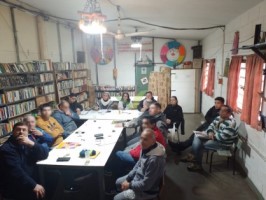
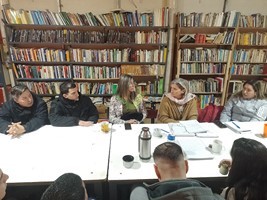
The prison's pacification committee and block representatives met with the visit supervisors
On the morning of this past Monday, the committee coordinated by Nancy Caballero met again, and together with representatives from the different pavilions of Unit 15, addressed the various issues affecting the people living in the prison, in an effort to find an immediate response to emerging needs — all this ahead of an upcoming assembly of the Committee.
Committee meeting
This time, the heads of the visiting section were present: penitentiary officers Jorge Plaza and Lisandro Pertossi, head and deputy head respectively.
They referred to the project to build the lockers — about 135 of them — which will not only allow visitors to store their belongings, but will also help make entry more efficient.
The representatives themselves proposed gathering the materials needed to build the spaces created for the comfort and security of visitors' belongings, recognizing how beneficial this will be for them and their visitors.
Changes to the admission of common-law partners
Both Plaza and Pertossi announced the pilot project under which permanent visit records will be created.
It consists of documenting the union between the person in a situation of imprisonment and his partner as common-law partners, without the need to go through the usual legal paperwork; in this case, the record will be issued at the unit's headquarters.
It was also clarified that anyone who decides to end a common-law relationship and intends to register another common-law partner with the prison authorities for admission as a visitor must not only remove the previous partner from the registry as usual, but will now also have to wait thirty days before the new partner can be admitted.
This waiting period, it was clarified, also applies in cases where it is the same partner with whom the person in a situation of imprisonment previously had a common-law relationship and who, for various reasons, had been removed from the registry and is later reinstated as a visitor.
If the person in a situation of imprisonment repeats the situation of removing a common-law partner from the registry for a second time, the waiting period for the new admission will extend to sixty days, and for a third common-law relationship, the waiting period will be ninety days.
Women listed in the visitor registry as friends, cousins, aunts, etc. will not be allowed entry, since it is understood that no visible family tie, such as a shared surname, links them.
It was noted that male visitors enter the unit with a simple registration for authorization, regardless of their relationship with the person in a situation of imprisonment.
It was also made clear that in order to carry out the visit known as an "encuentro" (private visit), common-law partners must, in that case, meet all the requirements of that section, including the proper legalization of the common-law relationship — the permanent visit record issued at the same headquarters will not suffice for that purpose.
Source: Prensa Liberté