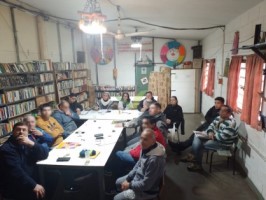

When the punishment cells of Batán Penitentiary Unit Nº15 were abolished, the intervention reached an inherited architecture: the same cell, with the same word and the same function that already operated in the detention centers of Argentina's last civilian-military dictatorship. It was a collective process, bringing together public bodies, community projects, men and women officials of the prison system and of ministerial areas, and organized people in prison.
Three public bodies —the Center for Legal and Social Studies (CELS), the National Penitentiary Ombudsman and the Provincial Memory Commission—, the Argentine State itself before the United Nations Committee against Torture, an institutional investigation by the Penitentiary Ombudsman published in 2008, and survivor testimonies from the Camps Circuit assert in writing that the isolation cells of the Buenos Aires Prison Service share a matrix, an architecture and a vocabulary with the dungeons of State terrorism.
Mailbox, pit, tube: the word is the same
"Buzón" (mailbox) has, in Argentine prison jargon, a precise meaning: the individual punishment cell where a person is held in isolation, with no contact, for 23 or 24 hours a day. It is the same word used by those who were political detainees in the seventies to name the dungeons of the detention centers where they were disappeared.
The testimony of Claudia Favero, a survivor of the Camps Circuit —the network of detention centers run by the La Plata Investigations Brigade under the last dictatorship—, was recorded in a publication of the Autonomous Workers' Center of Argentina about the historic verdict of the trial:
My brother Luis was put in one of those punishment cells, and they left me on the floor.
Claudia Favero. Una sentencia histórica: la larga noche del Circuito Camps (A Historic Verdict: The Long Night of the Camps Circuit), CTAA, 2012. · Permanent backup · Accessed: 25/05/2026.
The organization Sembrando Memoria, made up of former male and female political prisoners of the Coronda prison together with ATE Santa Fe, recorded in its historical archive a description of the regime applied in that prison between 1976 and 1983, attributed to the former political prisoner and union leader Victorio Paulón:
Coronda, during the Argentine dictatorship (1976-1983), implemented a daily regime that responded to the policy applied in all prisons and detention centers with the aim of annihilating anyone who thinks differently.
Victorio Paulón, in Sembrando Memoria / ATE Santa Fe. Coronda la cárcel: Notas históricas (Coronda the Prison: Historical Notes). · Permanent backup · Accessed: 25/05/2026.
The architecture, described by the agencies
The Committee against Torture of the Provincial Memory Commission surveyed those cells, and CELS brought that description before the Inter-American Commission on Human Rights:
The use of the isolation wings or punishment cells in the Province's Penitentiary Units constitutes one of the settings in which the right to personal integrity of prisoners is repeatedly violated. Confinement takes place in cells of 2x1.5 metros for 23 or 24 hours a day with a double door; generally without drinking water or personal hygiene items; in very dirty and unhygienic cells; in many cases without natural and/or artificial light; without heating or ventilation.
Center for Legal and Social Studies (CELS). Request for a thematic hearing on the use of isolation before the Inter-American Commission on Human Rights, March 6, 2013 (data from the Provincial Memory Commission, 2012 Annual Report "El sistema de la crueldad" (The System of Cruelty)). · Permanent backup · Accessed: 26/05/2026.
The Provincial Memory Commission's report on isolation in the Buenos Aires prisons describes those same spaces: sheet-metal doors and a food hatch as the only opening.
The Provincial Memory Commission's special report on isolation in the Buenos Aires prisons records a formulation by the researcher María del Rosario Bouilly that sums up its character within the regime:
The "buzones" —isolation cells— constitute the "worst" space in prisons whose conditions are generally bad. The wings designated for isolation, produced and used to differentially distribute populations as regards living conditions, represent the extreme of material and symbolic violence.
Bouilly (2015), cited in the Provincial Memory Commission. El aislamiento en las cárceles bonaerenses (Isolation in the Buenos Aires Prisons), April 2021, p.42. · Permanent backup · Accessed: 25/05/2026.
The dungeons where political detainees were held in the dictatorship's centers appear described in matching terms —same dimensions, double sheet-metal door, ventilation through a food hatch, prolonged confinement in solitude— in survivor testimonies and in the court rulings for crimes against humanity. What changes from one case to the other is not the cell. It is the population locked inside.
The sources state it in writing
The continuity is not only morphological. It is named, in writing, in public documents —and, in the strongest case, in a declaration by the Argentine State itself before the UN.
In November 2004, within the framework of the 33rd session of the United Nations Committee against Torture, the Argentine government acknowledged:
The practice of torture does not respond to exceptional situations or particular circumstances; rather, it is routine among the State's security forces, as a legacy of the last military dictatorship that the democratic governments have not been able to resolve.
Acknowledgment by the Argentine State before the UN-CAT (CAT/C/CR/33/1, para. 6, November 24, 2004), reproduced in National Penitentiary Ombudsman, Contribution before the UN Treaty Bodies. · Permanent backup · Accessed: 25/05/2026.
CELS, in a report sent to the UN Special Rapporteur on Torture (Sir Nigel S. Rodley) on October 24, 2001, concerning violations committed by the Argentine State during 2000 and 2001, made the same diagnosis:
The information gathered makes it possible to observe the following: a) the continuity of systematic practices of torture and even the worsening of the situation, mainly in certain institutions or jurisdictions.
Center for Legal and Social Studies (CELS). Report to the United Nations Special Rapporteur on Torture, October 24, 2001. · Permanent backup · Accessed: 25/05/2026.
In 2008, the National Penitentiary Ombudsman published Cuerpos Castigados (Punished Bodies) (Editores del Puerto), an institutional investigation directed by the researchers Alcira Daroqui and Carlos Motto, based on nearly a thousand surveys of people detained in federal prisons carried out during 2007 and early 2008. The central hypothesis of the study reads:
The prison sentence is, and is deployed, to a great extent, as corporal punishment through violent and degrading penitentiary practices —physical mistreatment and torture— against incarcerated people; these regular and systematic practices respond to governability strategies of a clearly institutional character.
Alcira Daroqui and Carlos Motto. Cuerpos Castigados. National Penitentiary Ombudsman / Editores del Puerto, 2008, pp. 29-30. · Permanent backup · Accessed: 25/05/2026.
An honest clarification: in the written body of the book, Daroqui and Motto do not formulate a single sentence that literally equates the architecture of today's punishment cell with the cells of the dictatorship. What they demonstrate, with empirical field work, is that prison isolation under democracy is a systematic and rationalized tool of the State, not an anomaly. The historical bridge between that demonstration and the dictatorial genealogy is completed by the agencies that deal with the problem and, also, by Daroqui's own voice at the public presentation event for the book (we return to it below).
The Provincial Memory Commission, which operates as the Local Mechanism for the Prevention of Torture in the Province of Buenos Aires, formulates that continuity in its 2021 Annual Report of the National Registry of Torture Cases:
Cruelty is the matrix of the power to punish deployed in the governance of the prison; that cruelty is expressed in an action that causes intense pain and suffering, and that action expresses brutality, ferocity and pitilessness. It is within that matrix that torture must be inscribed.
Provincial Memory Commission. Annual Report of the National Registry of Torture Cases, 2022 (report on 2021), p.99. · Permanent backup · Accessed: 25/05/2026.
The same report then includes a formulation by Alcira Daroqui on the everyday, structural character of that torture:
A cruelty that is not the product of extreme and extraordinary acts, but rather is part of an administration of everyday acts that penitentiary power exercises: they are the practices that injure and wound, that degrade, that humiliate, that do violence, which the detained person goes through all the time during prison confinement: it is life in prison. Practices that cannot be "justified" even within the framework of the exception. They are part of a technology; they are constitutive of a way of governing detained populations and subjects in their condition as prisoners.
Daroqui (2014: 44-45), cited in the same Annual Report of the RNCT 2021, p.99. · Permanent backup · Accessed: 25/05/2026.
The concept the agencies use: matrix, not continuity
The distinction matters. To say that punishment cells are a "continuity" suggests that something of the dictatorship "carried on." The reading sustained by the cited agencies is more structural: punishment cells are part of one and the same matrix, in the sense in which the Provincial Memory Commission uses the term — the pattern that organizes the everyday response of penitentiary power toward any person in prison: isolation and the rupture of the collective bond.
That matrix was not built in 1976. Between 1976 and 1983 it was systematized and applied as State policy against political detainees. After 1983, when the dictatorship's detention centers were closed, the matrix was not dismantled: the word and the architecture remained available. The population locked inside changed.
Alcira Daroqui said it in no uncertain terms at the public presentation of Cuerpos Castigados, on April 29, 2008, in the Green Hall of the Law School of the University of Buenos Aires, before the Dean of the School, the Penitentiary Ombudsman and a room of one hundred and fifty people:
This demands stances, precisely in relation to establishing a necessary dialogue between the past and the present regarding the violation of human rights by the so-called "security forces" of the State. Without that dialogue between the past and the present it will be very difficult for us to frame the problem of the violation of human rights in prisons.
Alcira Daroqui, words delivered at the public presentation of the report (Law School, UBA, April 29, 2008), transcribed in Cuerpos Castigados, p.XV. · Permanent backup · Accessed: 25/05/2026.
In that same intervention, Daroqui makes explicit the historical link that the written body of the book does not formulate in a single sentence:
Disappearance, death and torture are not solely the "patrimony" of the armed and security forces; many civilians were needed to carry them out and to cover them up; without civilians it would have been impossible… this machinery of torture and of the deployment of human rights violations would have been impossible had there not been an articulation between civilians and security forces.
Daroqui, public presentation (FCJyS-UBA, April 29, 2008), transcribed in Cuerpos Castigados, p.XVI. · Permanent backup · Accessed: 25/05/2026.
That is why abolishing the Batán punishment cells is not just a procedural change
In this framework, what was achieved at Batán's Unit 15 is more than an advance in detention conditions: it is an intervention upon an institutional inheritance of State terrorism, made from inside the prison system itself.
As the article on the closing of the punishment cells anticipated, the process was made possible by the articulation between organized people in prison, the agencies that accompanied them —the Committee against Torture of the Provincial Memory Commission, the National Penitentiary Ombudsman, the Permanent Assembly for Human Rights— and the collective projects that sustained the demand over time, among them the Proyecto Mecha.
What remains to be done
Unit 15 no longer has punishment cells. The rest of the Buenos Aires Prison Service and of the Federal Prison Service do. The Provincial Memory Commission's special report on isolation, published in April 2021, documents 392 instances of isolation surveyed across 29 places of detention in the Province of Buenos Aires during 2019. For the in-depth exhaustive survey —interviews with detained people, with penitentiary staff and monitoring in the wings— the report selected five units representative of their distribution across Buenos Aires territory: Units 1 (Olmos), 2 (Sierra Chica) and 23 (Florencio Varela) for men, and Units 8 (Los Hornos) and 50 (Batán) for women. In the Federal Prison Service, the thesis by Ramiro Gual on the federal regime records the use of punishment cells, "buzones" and protection wings in Federal Penitentiary Complex I of Ezeiza and in the Federal Penitentiary Complex of the City of Buenos Aires (formerly Devoto).
Under various administrative names —"sectorization," "transit cells," "Isolation and Sanction Sector"—, the punishment cells preserve, according to the cited surveys, the same characteristics that this article describes.
Abolishing the punishment cells of Unit 15 was possible. The question, today, is whether what happened in Batán can be replicated or whether it will remain an exception.
The answer, according to the sources that deal with the problem, does not depend on the word "buzón" or on the cell's dimensions. It depends on when, as a society, we decide that the matrix that organizes the prison can no longer be the one that was systematized during State terrorism.