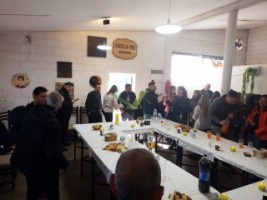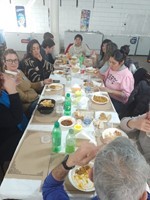

Its first day of service was July 9, 2022, as part of the Garantías de Independencia event: a gathering at which judges, officials from the Ministry of Justice, public defenders, and cooperative sector leaders came to Unidad Penal N°15 in Batán to share a locro (traditional Argentine stew) in what was still "a space under construction" between Liberté and Víctimas por la Paz. Two months later, on September 3, 2022, that space officially opened as Restaurante Punto de Paz: with tables, waitstaff, a varied menu of pizzas and pastas, two lunch sittings, and QR-code payment. What set it apart was who kept it running: every member of its staff was serving a sentence and was part of the project's management team. Punto de Paz became, for fourteen months, the first restaurant in the world run entirely by incarcerated people.
It was not Liberté's idea alone. It was a joint creation with Víctimas por la Paz, the association founded by judge Mario Juliano and coordinated today by Dra. Diana Márquez. That alliance — Liberté + a victims' association — is what sets Punto de Paz apart from any other productive enterprise run inside a prison anywhere in the world.
The opening: a table that dissolved distinctions
The inauguration was a symbolically charged event. For the first time in the history of the Argentine penitentiary system, crime victims and people serving sentences shared a table inside a maximum-security facility.
Present were institutional and social leaders from the carceral sphere, the widow of judge Mario Juliano, victims who had traveled from different regions of the country, and, of course, the incarcerated people associated with the project. Dra. Diana Márquez coordinated the day and brought Víctimas por la Paz's perspective from the very inception of the project.
A spread of cold cuts, pizzetas, sandwiches, and cake for dessert was served. But what defines the spirit of the place was not the food — it was a moment: during the inauguration, two incarcerated people were cooking, and one of the invited victims walked over to help. The other guests assumed she was part of the restaurant's internal team. The distinction dissolved into the human.
The concept: RESTORative
The project's name is not a forced metaphor. Punto de Paz is at once a restaurant — with its menu, its floor staff, its sittings, its till — and a restorative act — an encounter between victims and people who have caused harm, the repair of relationships, the recovery of dignity. Restorative justice, that paradigm so often discussed in academic forums, becomes here a very concrete experience: sitting down to eat together.
How it worked: four gestures that change everything
A diner would sit at a table, look over a menu, choose a dish, be served, pay for what they had eaten, and eat. That sequence of gestures — routine on the other side of the wall — took on an enormous symbolic weight inside the prison.
The furniture — tables, chairs, tableware — had been donated by Dra. Diana Márquez, president of Víctimas por la Paz, who also brought her prior experience in the hospitality industry to help structure the operation. Capacity was around 40 diners per sitting, across two lunch sittings (11:00–13:00 and 13:30–15:30) plus breakfast service.
The menu
Punto de Paz introduced dishes that had never before been part of the prison's food offerings:
- Pizzas, calzones, and empanadas
- Pastas: sorrentinos, ravioles, ñoquis
- Grilled meats and roast chicken
- Picadas and sandwiches
- Desserts: ice cream and cake
For special occasions and visits, the menu varied. The locro served on July 9, 2022 — offered to judges and officials gathered for the Garantías de Independencia event — stands as the symbolic prologue to the restaurant's formal opening.
100% digital payment
Cash is prohibited in the Buenos Aires province prison system. Punto de Paz therefore operated exclusively with digital payment: bank transfers and QR codes. This made it one of the very few fully digital enterprises operating inside a prison in the country.
The team
The restaurant ran with a small, tightly coordinated team. Seven people in total, all incarcerated and integrated into the project's management structure: two on the floor, two at the till and billing, and three in the kitchen. Kitchen staff also worked for the rotisserie; till staff also worked for the adjacent store.
Supply: the final node in an internal chain
Punto de Paz did not source its supplies in isolation. It was the final node in a productive chain operating within the same prison: the internal store provided raw materials and beverages, the rotisserie prepared preliminary dishes, the bakery supplied bread and pastries, the vegetable garden delivered fresh produce, and a secure corridor agreed with the SPB guaranteed access to authorized wholesale suppliers.
What happened at these tables
In the fourteen months it was open, Punto de Paz was far more than a restaurant.
It was the venue for five weddings between incarcerated people and their partners, supported by extraordinary civil operations that made it possible to issue DNI (Argentine national ID) documents to incarcerated people and their family members. Not only were family bonds strengthened — longstanding documentation gaps affecting basic rights were also resolved.
It hosted institutional gatherings: the already-mentioned locro of July 9, visits from judicial officials, ministerial representatives, and leaders from the penal system. And, above all, it was the site of restorative encounters: crime victims traveling from different regions — many of them brought together by Víctimas por la Paz — sharing a meal and a conversation with people serving sentences.
Fourteen months in numbers
Punto de Paz operated as a restaurant from July 9, 2022 to September 4, 2023: fourteen months in which it proved, every single day, that the formula was possible.
In those fourteen months it served approximately 10,500 meals at lunch and 3,500 breakfasts, celebrated 5 weddings between incarcerated people and their partners, and received at least ten press features in national and international media. Pizzas, pastas, locros, weddings, judges in conversation with people serving sentences, victims who came to a table the system never expected to exist.
Why it closed
Punto de Paz closed on September 4, 2023 due to a combination of two factors. On one hand, changes in the leadership of the Servicio Penitenciario Bonaerense altered the conditions under which the restaurant had operated: the secure supplier corridor, internal movement permits, and visitor protocols that had made the experiment possible — piece by piece — began to change. On the other hand, it was a decision made by Liberté itself: to close a chapter when everything had already been done. We had proved it was possible. We had set the table the system never expected.
The physical space remained standing. Today it operates as a community dining hall: a simpler version of the original project. But the restaurant's mark is still there — in those who inhabited it, in those who visited it, and in every dish that passed across those tables.
What came next
Closing the restaurant was not closing the project. Roberto M., Punto de Paz's head cook from the very first day, is today general coordinator of Liberté and teaches the cooking course within Universidad Liberté, where he passes the craft on to fellow members who are learning to sustain the gastronomic production chain for the institutional events the cooperative continues to organize. The kitchen did not go dark: it was redistributed.
The alliance with Víctimas por la Paz did not end either. It grew stronger. The 2nd Maratón por la Paz (November 2022, while the restaurant was still operating) and the restorative encounters that followed continued to draw on the network of relationships Punto de Paz had built across its tables. The methodology remained. The bonds remained. The proof that it can be done remained.
Why it matters
Punto de Paz was the only restaurant in the world fully managed by incarcerated people, and the only one that actively integrated crime victims into its design, inauguration, and daily operation.
It was not a cafeteria. It was not a vocational workshop. It was a real restaurant, with its menu, its sittings, its staff, its till, and its customers. And it operated inside a maximum-security prison for more than 425 consecutive days.
The project's reach extended beyond borders. In November 2024, the American magazine YES! Magazine devoted an in-depth feature to the Liberté model, explicitly citing Punto de Paz as a turning point in the articulation between incarcerated cooperativism and restorative justice.
In a country where public debate on safety almost always begins and ends with punishment, Punto de Paz offered a different answer: restoration is possible. And it can happen around a shared table.
A joint creation of Liberté and the association Víctimas por la Paz · General coordination: Dra. Diana Márquez.