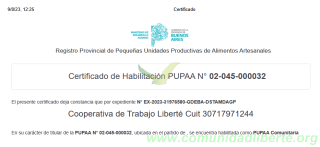

At Liberté we know what changes when there is dignified work. That is why we celebrate a milestone we feel is our own: our kitchen, "Cocina Liberté", is certified as a PUPAA (Pequeña Unidad Productiva de Alimentos Artesanales — Small Artisanal Food Production Unit) comunitaria. We are the first community PUPAA self-managed by incarcerated people to be certified in Argentina.
What a PUPAA is
PUPAAs are small units that produce artisanal food on a small scale and with low health risk, in individual or community kitchens. They were created under Resolution 150/2020 of the Ministry of Agrarian Development of the Province of Buenos Aires, which established the Provincial Registry of Small Artisanal Food Production Units (published in the Official Gazette on December 4, 2020).
The idea is to shift from a punitive approach to a preventive and educational one: to recognize small-scale production — deeply rooted in local communities — and integrate it into the formal food system. The process is free of charge, includes QR code traceability, training for producers, and provincial health certification. PUPAAs can be individual or community-based.
A certification that marks a milestone
Our unit is registered as PUPAA N° 02-045-000032, certified as a Community PUPAA by the Buenos Aires Ministry of Agrarian Development in August 2023. It operates inside Unidad Penal N°15 in Batán and produces a wide variety of goods: baked goods, alfajores, conitos con dulce de leche, cookies and biscuits, syrups, vinegar pickles, garrapiñadas, dehydrated fruits and vegetables, pizza bases and tortas fritas, among others.
The details on the certificate convey the full weight of this milestone: the holder is Cooperativa de Trabajo Liberté (CUIT 30-71797124-4) and the establishment is registered as "Cocina Liberté" in the Provincial Registry of Small Artisanal Food Production Units, under file EX-2023-31976580-GDEBA-DSTAMDAGP.
As holder of PUPAA N° 02-045-000032 Cocina Liberté, located at Ruta 88 Km 8.5, in the locality of Batán, partido de General Pueyrredón, it is certified as a Community PUPAA.
Having the provincial government recognize and certify a kitchen self-managed by incarcerated people carries a weight that goes beyond the administrative: it shows that, with support and opportunities, formal, quality work with added value can be produced from inside.
The work and the networks that made it possible
This achievement is collective, but it has a first driving force with a name attached to it: the idea came from a proposal by Erica Ávila Echeveste, a Liberté collaborator, who suggested starting with the concrete — adapting the kitchen to the required conditions and running food handling courses. From there, from the training and the preparation of the space, everything else grew. But Erica did not stop at the idea: she continues to join healthy and responsible cooking activities — we have cooked alongside her — and supports Liberté in every initiative, just as Jorge Taylor does.
Along the way, a key presence was that of veterinarian Jorge Taylor — a lecturer at the Universidad Nacional de Hurlingham (UNAHUR) and director of the Safe Food Production Program (PESAL) — who at that time was a PUPAA inspector and came in person to the prison, to Liberté, to assess the space and grant the certification. All of this connects with our commitment to food sovereignty and with the Cultivando Soberanía diploma program at Universidad Liberté.
A kitchen that sustains community life
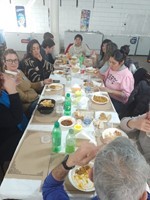
First and foremost, the kitchen sustains Liberté's daily life: what is produced there keeps the community dining room and community breakfast running, and is used to welcome visitors who come to learn about the space. It is also the classroom for the gastronomy courses offered at Liberté with certification from Universidad Liberté: participants learn the trade by preparing food that is then shared with the Liberté community.
Why this matters to us
A PUPAA is much more than a registration: it is a way of recognizing small-scale work and giving it a place in the formal system. For us, it means producing healthy, safe, artisanal food from inside a prison and training in a trade. And it means, above all, demonstrating that with opportunities, a future can be built from the inside too: dignified work, made with our own hands and with an identity of our own.