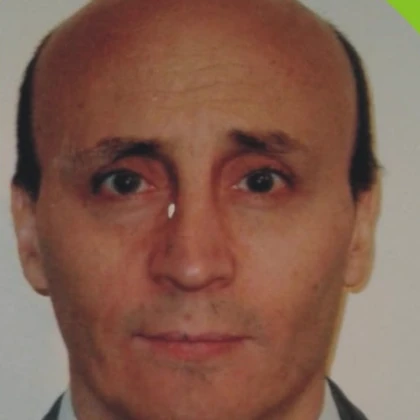

From Unit 15 of Batán —a maximum-security prison that is, also, Liberté territory— and simultaneously by video call, a community sat down on a Friday afternoon to think about the world. It was October 24, 2025. In the Punto de Paz hall, in hybrid mode, Hernán Alberto Terneus gave an open class: an Ecuadorian based in Argentina, holder of a degree in Meteorology and a consultant for the United Nations, the World Bank and the Inter-American Development Bank. The topic: the management of international conflicts. Strategies and perspectives to prevent, understand and resolve them.
The gathering was an EnClave Libre, the Universidad Liberté format that, outside the diploma programs, brings open classes to the community —including people in prison— in hybrid mode, with the support of the Víctimas por la Paz association. It was opened by Pampa, president of Cooperativa Liberté, who thanked Terneus for making the effort to travel from Buenos Aires «to be with us, to get to know Liberté». He was accompanied by his life partner, Silvana Greco, who did not participate actively that day but joined the diploma program the following day.
Diana Márquez, secretary of the cooperative\'s Board of Administration, then spoke, framing the class within the project of Liberté\'s Free, Popular and Self-Managed University: «Having Alberto Terneus here today is a privilege», she said, and explained she had met him through Silvana Greco. «He has an ability to convey what he knows… and what he knows is enormous.» What followed was a conversation of more than two hours —with questions from the room and from Zoom— that traveled from the seventeenth century to the war in Ukraine without losing the thread.
Watch the full class on EduTube.
«Content doesn\'t matter: what matters is teaching people to think»
Terneus opened by saying that the topic «shows we are all connected»: the great phenomena traversing the world —he evoked the tango Cambalache, by Enrique Santos Discépolo— have been happening throughout history and will keep happening. He then warned that international conflict is «a fairly complex subject» and that, to avoid getting lost, one must work carefully and by levels of importance: from the individual to the common, to the national, and to the international. His goal was pedagogical: that by the end of the talk each person would feel «more entitled» to have an opinion about what happens in the world, with their own way of thinking. He expressed this with an image he repeated all afternoon: learning to think «like foreign ministers». To understand education in Argentina —he illustrated— you have to think like a minister, not like a student: the student wants to pass and take vacations; the minister has to think about the development of the system over the medium term.
To establish that method, he turned to two thinkers he called «very lucid». The first, Baruch de Spinoza, born in Amsterdam in 1632, who said about education: «I am not interested in the content given to students in the classroom. I am interested in teaching them to think», because content changes with the times and what endures is knowing how to think «with order, with logical connection». Spinoza, Terneus explained, distinguished four ways in which a person perceives that they are learning. The first is being told: a piece of information taken as unquestionable without firsthand knowledge —«that\'s how rumor works»—. The second, chance experience: the knock on the knee, the burn from hot oil; «disordered accumulations of experiences» that do not constitute knowledge. The third, widely used in politics, is attributing to an effect the cause that suits whoever wants to install a way of thinking: lightning strikes, a tree burns, and someone proclaims the end of the world. «You cannot attribute to an effect a cause», he noted; the natural direction is the reverse.
The fourth «is the true one and the arduous one»: noticing where the lack of understanding lies, recognizing what kind of phenomenon it is —whether agronomic, veterinary, mechanical or electrical—, identifying its critical variables and working in an orderly way. «It is a task of gradual deepening… returning to one\'s inner self, reviewing what one thought, finding out more, moving forward.» That, he said, is the knowledge that «will accompany us the most» and the one that «consolidates a community that deciphers, thinks and shares».
The second thinker was Immanuel Kant and his text Toward Perpetual Peace, from the late eighteenth century. His starting point: just as relations between individuals within a country are regulated by law and economics, so too are relations between countries. And the key insight, Terneus underlined: the condition of citizen «is anchored in the legal and economic relations that configure the State», and the State «notifies» the citizen of the level of citizenship they live in. If it guarantees education, health, housing and care for workers, it signals that any move they make will be supported; if it withdraws from education, health and housing, «they are notifying that the condition of citizenship is evaporating, and rapidly».
The anatomy of a conflict: axes and capacities
Before the case studies, Terneus laid out the board. States, he said, are part of a cosmopolitan space ordered by the United Nations Charter and its agencies —education, agriculture, industrial development, refugees—. He recalled that the system brings together nearly two hundred member states, each with its quota based on the size of its economy, and asked the community to keep that in mind: «The United Nations system belongs to all of us». It works, he compared, like the great ministries of the planet: education, health, environment, agriculture, refugees, weapons, organized crime, trade, meteorology.
With the blackboard in front of him, he built a chart. On one axis, the manifest character of the conflict —what it is predominantly identified with—: environmental, territorial possession, economic, financial, political (with its two dimensions, the ideological and the potential threat) and, «the most sublime of human thought», the religious. On the other axis, the management of the conflict, with its levels of intensity: from the exchange of diplomatic notes («We have noted with great displeasure…») to threats and destabilizing moves, armed incursions or cyber intrusions into critical systems, all the way to «all-out war».

Diplomacy schools, he explained, use this to build a prescriptive plan: they categorize the conflict and prescribe how to manage it according to its type. But «in real life» what matters is something else: the capacity of those in charge of deciding the pace. And here he introduced the scheme of core capacities, which works «for any group that wants to do something well»: critical knowledge of the conflict\'s subject matter; sound internal democratic functioning —which includes training younger members with the experience of those who came before—; and the capacity for connection, for «reading the environment» and asking for help from those who know. He illustrated this with a small-town pharmacy that cannot manufacture a single aspirin and a laboratory that delivers it immediately «because it has people who know, people who find a way to be faster». «Managing a conflict works the same way.»
When diplomatic bodies capable of genuinely understanding what is happening come into play, he added, the model becomes three-dimensional: a «conflict complexity space» and a «managerial complexity» space appear. And one more axis, which «comes out of the corner of the classroom toward the floor»: that of communication, because governments must account to their population for what they do.

From the end of Easter Island to the Mediterranean
With the board set up, came the cases. Easter Island between the sixteenth and seventeenth centuries: each clan carved its totems and transported them on log rollers, until the competition deforested the island, neglected agriculture and «degenerates into cannibalism, which is the end of society». A conflict that was, at its core, environmental.
The famine in the Sahel in the seventies, which was presented as a natural catastrophe when it was «a political catastrophe»: food was not coming in because armed factions prevented it, and the former colonial countries blamed each other. Its continuation today, he said, are the people displaced by environmental impoverishment and climate change who cross the Mediterranean —many die in the crossing— and whom the destination countries receive as «a political challenge»: «You are sending us displaced people», «look, they are environmental refugees», «you were our colonizers».
In economic terms, Terneus read the current situation of the United States —«the most indebted economy in the world»— as a double play: making it harder for products to enter that would unbalance it, and «expanding the use of our currency», so that each bill is backed by the material assets —land, roads, industries— of other countries. He called this «an expansion of financial possession» and mentioned Ecuador and Panama, both dollarized, as examples.
To show what happens when someone does not understand the nature of a conflict, he told an anecdote: a specialist in personal conflicts who, returning from Salta, explained his plan to «manage climate conflicts» by watching the delegates at a summit through a glass and switching on a yellow light when the conversation stalled. The problem, he illustrated, is that the specialist ignored the essential point: the delegates attending a Conference of the Parties arrive with confidential instructions from their heads of state —«I cannot move beyond this line»—. «It is impossible for someone who does not understand the complexity of an environmental conflict to notice» why a negotiation stops; that is «a lack of competence to engage with that conflict».
Then came Ukraine. Terneus narrated it as a movement on the management axis: after the dissolution of the Soviet Union, provinces that voted in referendums to join the Russian Federation; NATO bringing weapons closer; an escalation he compared to the 1962 missile crisis —when, he recalled, the Bay of Pigs plan was aborted with the help of Rodolfo Walsh, who decoded the CIA\'s encrypted message in Havana—. According to his account, the Russian Federation responded with a «special military operation»; NATO proposed a pause for a political solution; and, two years later, Ukraine had grown stronger. «They put us to sleep», Moscow\'s reading summarized: a truce used to gain an advantage «on the management axis». A move, he said, «deceptive, but it happened». On the linkage axis he placed another example of incompetence: signing a free-trade agreement by which foreign high technology —chips— enters tariff-free in exchange for exporting chips the country does not manufacture.
The silenced axis: communication
Editorial note. The figures and current-affairs data that Terneus cites in this section form part of his own analysis.
The communication axis, he warned, can also be a theater of conflict, especially when it is silenced. He recalled the Gulf War of the early nineties, announced «with great fanfare», and paired it with Karl Marx and his The Eighteenth Brumaire: the episodes of history, Marx wrote following Hegel, seem to repeat themselves «the first time as tragedy and the second as farce».
The Argentine example was one that, according to Terneus, «the population still does not know because the communication axis is deliberately silenced». He claimed that whoever is leading the country donated —«not sold, donated»— to a conflict in Eastern Europe military equipment worth a figure he set at nine hundred million dollars, equivalent, he said, to two and a half years of salaries for seventy thousand public employees: two military helicopters, two dozen F-16 jets that were to be purchased from Denmark, and the previous year, five Super Étendard aircraft, «the ones that fire Exocet missiles». For him, the fact that none of this was communicated «amounts to a failure in the function responsible for oversight of a country».
The abstract and the concrete: hidden agendas
The second part of the class, briefer, revolved around a distinction. Terneus warned against the uncritical adoption of «recommendations that worked in my country»: an imported manual —his example was «the Japanese method»— is an abstract totality that, transferred as-is to Argentina, does not work. The missing step is passing through the concrete totality of the country —its scale, its resources, its social aspirations— so that it «comes down explained». Without that step, hidden agendas do the rest.
He extended this to what he called the possible «third great European war». If NATO was created to prevent wars against external enemies, he asked, why have the great European wars —from the Thirty Years\' War to the two World Wars— always been between Europeans? He recalled the sequence of invasions of Russia: Napoleon, who advances and is defeated; Hitler, who in Mein Kampf proclaims German expansion to the East and also «bounces back». But this time, he said, there is a new actor: the private sector. He spoke of arms supply contracts already signed that constrain any negotiation, and quoted President Dwight Eisenhower, who in his final address to the nation warned that the political agenda was being «hijacked» by what he called the military-industrial complex. Today, Terneus stated, high-ranking generals are shareholders in weapons companies.
«You have to follow the money trail»
He then moved to the figures that, he argued, explain many conflicts beneath their manifest character. He stated that two percent of world gross domestic product is spent on weapons —«in Argentina, not even education, science or technology gets two percent of GDP»— and that NATO aims to raise its spending to six percent; adding salaries, vehicles, facilities and contracts, he calculated security and defense spending at fourteen percent of world GDP.
On that money he built his central thesis. Citing the United Nations Office on Drugs and Crime, he enumerated the world\'s major mafias —the Calabrian \'Ndrangheta, the Sicilian Cosa Nostra, the Neapolitan Camorra, the Chinese triads, among others— and identified the Calabrian one as the richest, with a turnover he set at six hundred billion dollars a year. That money, he said, is recycled with the help of investment funds, and he named the largest of all, BlackRock, to which he attributed ownership of sixty percent of Ukraine\'s cultivable land and the role of principal funder of the arms industry —Boeing, Lockheed, Airbus—. Of the thirty entities that most finance that sector, he stated, eight are banks and the rest are investment funds.
To organize the idea he turned to an Argentine figure: the triangle of Jorge Sábato, one of the founders of the National Atomic Energy Commission, who conceived the virtuous interaction between the State, academia and companies. Against it, he proposed a «war triangle» with three vertices —transnational corporations, financial companies and armies— and a question: «Where is the State? It was co-opted». That is why, he said, quoting the anti-mafia judge Giovanni Falcone, in today\'s conflicts «you have to follow the money trail». Under that lens he reread Donald Trump\'s threats over Greenland, Canada and the Gulf of Mexico not as «rantings» but as strategic control of routes and missile monitoring; the conflict in Gaza as fuel for the arms industry; and the pressure on Venezuela in relation to its hydrocarbon reserves.
On the linkage axis he placed a nearby example: an agreement by which South American countries commit not to allow flights to the disputed islands in support of Argentina, and a government that breaks that pact and authorizes flights «for logistical reasons» tied to «private, opaque» money linked, as he suggested, to the cocaine hydrochloride route toward Europe. His conclusion ran through the entire class: many conflicts «are not ideological», even though they may appear so —that is their manifest character—; they are «the movements of capital, which are like magma» beneath the continents. And he warned about the use of the communication axis «to poison the population», with an example: the campaigns against Pope Francis, which Terneus linked to his dispute with sectors of power within the Church.
National density: what can be done
Terneus returned to Kant\'s point to close the arc. When a State «notifies» that citizenship is evaporating —because it withdraws from education, health and public care—, he said, one must take precautions: «The State is ours, it took a long time to build and defend it». He recalled that long processes are not reversed in a week —«the solution will take ten years, twenty years»— but they must be sustained, and he rejected the idea that there is «a single form of reality, a single reading».
To name what a country needs, he used a concept from Aldo Ferrer: national density, sustained by four pillars —consolidation of institutions, management with a national imprint, critical thinking and social cohesion—. «The population must know where it is living and why we do something like this.» With that density, he concluded, returning to Spinoza, «it does not matter what content is discussed in the world» or what era: a country preserves its identity. «We must reclaim that.»
Questions from the room

Diana Márquez bridged the class and the discussion. She highlighted Terneus\'s movement «from the macro to the micro», and brought it home: one cannot understand «the conflict that arises in the community, in our Liberté territory», without these theoretical frameworks «that help us think, opening our minds», without remaining «in our small square meter».
From the room, Daniel Q. spoke up, introducing himself as sixty years old with the feeling of having witnessed «this country and the world in different situations». His question was that of the citizen who watches the great movements of power «on television», with anxiety, feeling that «we can do nothing more than watch it go by»: «What can we —ordinary citizens— do to at least feel that we can form a choice?»
From Puerto Madryn, in Chubut, Susana Elba López offered a reflection: she asked that everyone remember the people fleeing war zones —from Ukraine, from the Gaza Strip, the Europeans who once emigrated to the Americas— and suggested that the intelligence of a great many people «keeps those wars» confined to those who want to wage them. Diana Márquez added her own: what place does democracy have «as government of the people» in all of this, and why, even amid the diversity of opinions that enriches it, does «this winning or losing» end up weighing so heavily, with the feeling that «we are almost always on the side of those who lose». «Maybe —she answered herself— it is because we are looking at it from below.»
«We are a minority, but not just any minority»
«Those are three very good questions; all three converge», Terneus replied. The first thing, he said, is «to legitimize oneself to think critically». He brought in Mark Fisher and his Capitalist Realism —the «there is no alternative» that Margaret Thatcher proclaimed while dismantling the British productive system— to ask whether that realism is truly «without alternative». He distinguished, with humor, the real (what is seen), reality (its treatment), the realist (whoever takes a position from the real) and realism (whoever believes that «nothing else matters»).
To show that there has always been another way of reading, he turned to Antonio Gramsci, who wrote his Prison Notebooks during more than a decade of imprisonment under fascism, and to his concept of hegemony: the worldview that the powerful impose as the only one —«don\'t think, I\'ll tell you»—, which is, he warned, the first error Spinoza identified and the antechamber of fascism. He then traced a path through political economy: Thomas Malthus and the idea that «social justice is an aberration»; the dispute between Martin Luther —for whom the human being carries evil within— and Thomas Müntzer, «the first socialist theologian of Europe», who said that «nothing is more sacred to a human being than another human being» and who was crushed in the sixteenth century; the arrival of those ideas to the British Isles with Thomas Hobbes\'s «man is a wolf to man» in his Leviathan; and the «invisible hand» of Adam Smith, who imagined society as a machine lubricated by self-interest.
Against that current he placed another. In Judaism, he said, the first commandment is not «love your neighbor as yourself» but «love the other as yourself»: «the other comes first; thanks to the other we exist». He recounted —following Hermann Cohen— how the Hebrew word for «other» was translated in the Septuagint as «neighbor» and later, in the Vulgate, as «fellow», and how that shift «distorted» a central precept. He showed its extreme reverse in the language of Nazism, which went so far as to classify human beings to the point of denying them their human condition. And he closed that passage with Martin Buber: doing evil «is very easy» —through violence, through impulse, through inaction—; doing good «is laborious, it requires understanding, renunciation, dedication».
The close was a legend. That of the thirty-six just ones: in the world there are thirty-six just people who do not know they are, and who hold the social fabric together so it does not tear. Their lesson, for Terneus, is to behave virtuously not for reward or out of fear of punishment, but out of conviction. From there his message to the community: «We are a minority, but not just any minority». A minority that «upholds the banner of justice, participation, inclusion, love for the other, and solidarity» —«in Hebrew, justice means solidarity»—. He called for a participatory democracy that does not exhaust itself in voting, for «forming at least communes» and beginning to work, with the certainty that what seems lost today «in a decade we will reverse». He quoted Walter Benjamin and his automaton that played chess moved by a hidden dwarf, to say that «the sensitive ones» stop losing when they stop accepting the theology others impose on them. And he recalled that no species prospers «without bonds of association»: «We must sustain the conviction that we are right, we have solidarity, we have vocation. Let us associate.»

Time —and the satellite connection— worked against the gathering all afternoon. «The satellite drops in a minute», Pampa warned more than once, and Terneus wrapped up to applause. Miguel Ángel M., who had opened the gathering, bid him farewell on behalf of Universidad Liberté and Víctimas por la Paz, from «the maximum-security prison of Batán and Cooperativa Liberté», and promised a next gathering «en clave libre».
Who was there
The EnClave Libre was organized by Universidad Liberté together with the Víctimas por la Paz association, in hybrid mode: one group present in the Punto de Paz hall, at Unit 15 of Batán, and the rest connected by Zoom. In attendance were Pampa, president of Cooperativa Liberté; Diana Márquez, secretary of the Board of Administration; and Silvana Greco, the speaker\'s life partner. From the room, Daniel Q. participated, and by video call from Puerto Madryn, Susana Elba López. The opening and closing were led by Miguel Ángel M.